Lets Create Something Beautiful.
We believe in creating meaningful experiences that inspire and connect. Let us help you bring your vision to life.
Quality First
We deliver exceptional results in everything we do, ensuring your satisfaction at every step.
Expert Care
Our experienced team brings skill and passion to every project, no matter the size.
Real Results
Proven outcomes that speak for themselves and make a meaningful difference for your home or business.
Lets Work Together
Coastal Wall Creations
Hours
Mon | 09:00 am – 05:00 pm | |
Tue | 09:00 am – 05:00 pm | |
Wed | 09:00 am – 05:00 pm | |
Thu | 09:00 am – 05:00 pm | |
Fri | 09:00 am – 05:00 pm | |
Sat | Closed | |
Sun | Closed |
How This Works
How our WP-UV-T2 works
Advantages of the UV ink it uses vs. other printer ink types
How our WP-UV-T2 works
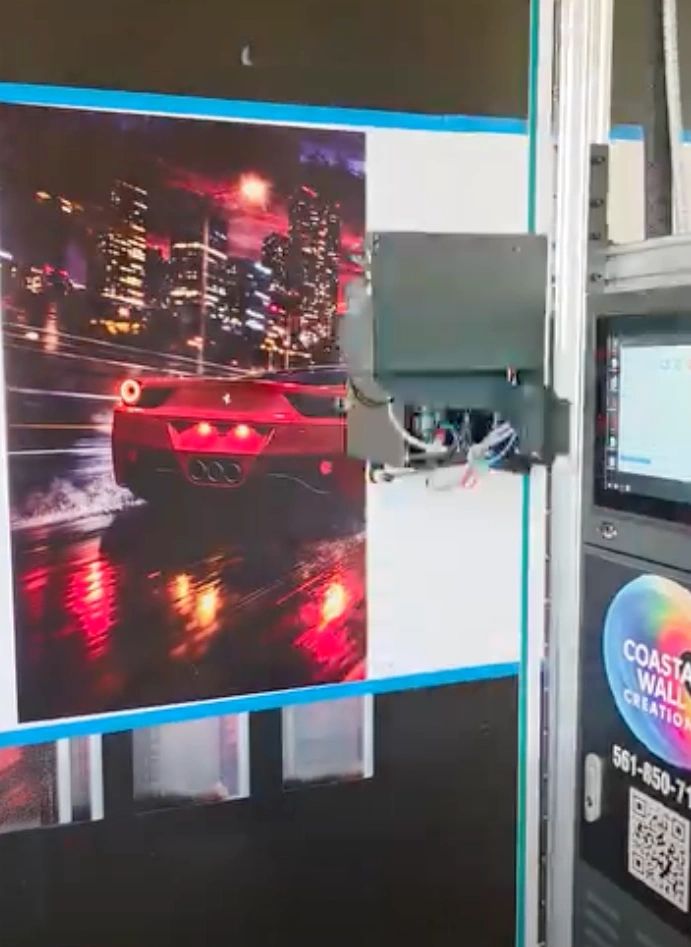
The WP-UV-T2 is a vertical inkjet wall printer: it moves a printhead up/down while the machine advances left/right along the wall to “scan” and place ink dots in a grid, similar to a large-format inkjet—just rotated to print on a vertical surface. Many systems in this class use a guided rail + motor-driven motion so the printhead travels smoothly and stays aligned across long murals.
What makes this style of wall printer stand out:
Precision alignment aids: implementations commonly include a laser crosshair / alignment reference to help position the image on the wall and keep the pass-to-pass registration accurate.
Automatic wall-distance tracking: many units use ultrasonic sensing to maintain print quality when the wall isn’t perfectly flat (bumps/texture/minor waviness).
White-ink capability for dark surfaces: promotional material for the WP-UV-T line highlights white printing so colors can appear correctly on darker or non-white walls (often by laying down a white base under CMYK).
Scalable mural width: these printers typically have “unlimited” width in practice by printing in sections/passes as you move the machine along the wall.
Surfaces we print on
Advantages of the UV ink it uses vs. other printer ink types
How our WP-UV-T2 works
In general, UV wall printers (including WP-UV-T–type machines) can print on a wide range of porous and non-porous surfaces such as:
- Drywall / painted interior walls, plaster
- Concrete / cement, brick, block
- Tile
- Wood (paneling, doors)
- Glass
- Metal
Practical “what actually matters” when choosing a wall:
Clean + dry beats “perfect”: dust, chalking paint, oils, or moisture reduce adhesion and sharpness—so wiping/degreasing and fully drying is often the difference between a crisp mural and a fuzzy one.
Texture level affects detail: heavy knockdown, deep stucco, or very rough brick can still print, but fine text and tiny details soften because ink lands on peaks/valleys.
Very slick materials may need prep: smooth glass/metal/tile can work well with UV ink, but some workflows use primers/coatings to improve bonding on ultra-slick or high-touch surfaces (especially if the wall will be scrubbed).
Outdoor walls: UV wall printing is often marketed for exterior use because cured UV ink is designed to hold up better to sun and weather than many water-based wall-print approaches (still, real longevity depends on exposure + whether you clear-coat).
Advantages of the UV ink it uses vs. other printer ink types
Advantages of the UV ink it uses vs. other printer ink types
Advantages of the UV ink it uses vs. other printer ink types
UV wall printers use UV-curable ink: instead of drying by evaporation (like many water-based inks), the ink is cured (hardened) rapidly by UV light, which changes the ink into a solid film.
Key advantages over common alternatives:
Instant curing / faster handling: prints can be “dry” almost immediately because they cure under UV light rather than waiting for water/solvent to evaporate. (This reduces smearing and speeds production.)
Durability: UV-cured prints are widely promoted as more resistant to fading (UV exposure), moisture, and abrasion, making them better suited for high-traffic areas and many outdoor applications than typical water-based prints.
Broader material compatibility: UV inks can adhere well across porous and non-porous surfaces (wood/concrete and glass/metal), which is harder for many water-based systems without special coatings.
White ink (and sometimes varnish): UV platforms commonly support CMYK + White, enabling a white underbase for dark walls and more accurate color on non-white substrates—something many standard inkjet setups can’t do well.
Coastal Wall Creations
Copyright © 2026 Coastal Wall Creations - All Rights Reserved.
Powered by GoDaddy
This website uses cookies.
We use cookies to analyze website traffic and optimize your website experience. By accepting our use of cookies, your data will be aggregated with all other user data.